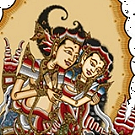
Dewa Semara and Dewi Ratih: Difference between revisions
(Created page with "{{Paintings02 |Title=Dewa Semara and Dewi Ratih |Artist=Unknown |Date=1981 |Size=40 x 50 |Collection=Private collection }} {{Dewa Semara and Dewi Ratih}} ") |
No edit summary |
||
| (3 intermediate revisions by the same user not shown) | |||
| Line 1: | Line 1: | ||
[[File:Kamasan - smara and ratih.jpg|thumb|386x386px|''The story of Dewa Semara and Dewi Ratih has become an inspiration for painting artists.'' ]] | |||
{{Paintings02 | {{Paintings02 | ||
|Title=Dewa Semara and Dewi Ratih | |Title=Dewa Semara and Dewi Ratih | ||
| Line 5: | Line 6: | ||
|Size=40 x 50 | |Size=40 x 50 | ||
|Collection=Private collection | |Collection=Private collection | ||
}} | |Material=Natural pigments on cotton cloth}} | ||
{{Dewa Semara and Dewi Ratih}} | {{Dewa Semara and Dewi Ratih}} | ||
[[Category:Kamasan paintings]] | |||
Latest revision as of 21:01, 6 January 2026

| Title | Dewa Semara and Dewi Ratih |
|---|---|
| Artist | Unknown |
| Date | 1981 |
| Size | 40 x 50 |
| Material | Natural pigments on cotton cloth |
| Remarks | |
| Signature | |
| Published | |
| Collection | Private collection |
Dewa Semara and Dewi Ratih - Mahabharata
The tragic story of Saint Valentine in Europe inspires the celebration of Valentine's Day every February 14th. In fact, in Bali there is also a love story between Dewa Semara and Dewi Ratih which can be used as a reference for building good relationships with partners, other people, or even with yourself. The love story of the two is called Sang Hyang Semara Ratih, written on Cundamani II ejection.
In Balinese Hindu belief, Semara is the island’s god of love. He is young, radiant, and charming. With a bow made of sugarcane and flower-tipped arrows, he awakens desire, not pain. His presence brings people closer, filling hearts with warmth.
Beside him stands Dewi Ratih, also known as Sang Hyang Ratih or Sang Hyang Semara Ratih, a Hindu lunar goddess, worshipped in Java and Bali. She is well known for her beauty and grace, thus she was also known as the Goddess of Beauty. Dewi Ratih symbolizes emotional devotion, loyalty, and serenity. Her myth is linked to lunar eclipses. Together, Semara and Ratih form a divine balance. Where Semara sparks passion, Ratih nurtures it with patience and grace. Their union shows how real love is born, not only from desire but also from deep emotional bonds. The couple reflects the ideal harmony in relationships. In Balinese culture, their story teaches that balance is key to lasting love.
Semara and Ratih are not just gods from the past. Their story is still alive in the hearts of Balinese people. During ceremonies, offerings, or quiet prayers, many couples ask for their blessings. Their love is a symbol of emotional strength and spiritual connection. In a world where relationships often move too fast, their legend reminds us to slow down. It encourages us to nurture our connections with patience, care, and balance.

Balinese humanist I Gede Anom Ranuara said the story of Sang Hyang Semara Ratih is a mythology created to convey the message that the male (masculine) and female (feminine) souls always exist in every human being. These two 'souls' are needed by every human being in order to live his life well.
"That is needed in activities, when do we need power for the masculine, when do we need power for the feminine. Because it is impossible in life to be all feminine or all masculine. This means that these two elements must be awakened, that is the hope of life itself," said Anom Ranuara.
In the Smaradahana Lord Shiva also promised that Dewa Kama (Semara) and Dewi Ratih would 'live' forever in the hearts of every human being, male and female who are aware of their swadharma.
"We still refer to monodualism in Hinduism, two are one, one is two. In the Ardanareswari puja we are grateful to Ida Sang Hyang Widhi Wasa in the form of both a man and a woman. Semara Ratih is actually there," said the humanist, who is familiarly called Guru Anom.
Guru Anom further said that the single form of Dewa Semara and Dewi Ratih, Sang Hyang Semara Ratih, is worshiped in a number of Hindu rituals in Bali. For example, the presence of Sanggah Surya at the time of the mekala-kalaan (mabeakala) wedding ceremony is the niyasa (symbol) of the stanas of Dewa Surya and Sang Hyang Semara Ratih.
The inauguration ceremony for the construction of a new house (ngetok sunduk) also begins with a prayer to Sang Hyang Semara Ratih. Also, in the metatah (tooth-cutting) ceremony at the beginning of its implementation, they pray and ask for the holy water tirta before Dewa Surya and Sang Hyang Semara Ratih. "Why is Semara Ratih's rerajahan raised at metatah? Because at that time we are considered to know our identity by knowing the 6 elements of Sad Ripu. When you can feel that the 6 elements are enten people or jagra people, people are aware and know their identity," said this humanist from Kesiman Traditional Village, Denpasar.
Guru Anom: “Although the story of Sang Hyang Semara Ratih departs from a mythology, there are many values that humans can learn today. That the balance between masculinity and femininity must be maintained by everyone so that their life goes well. Today's children think mythology is made-up stories. But if we use logic, we will understand what it means."
More info: